

Saturday, 8 February 2014
There are throws in Taekwondo!
In my last blogpost I wrote about an application from Poomsae Jitae. Actually I wrote about two applications from that Poomsae one being a leg sweep and the other being an armbar followed by striking techniques. One thing that really bugs me when surfing the world wide web though is all the people out there who says Taekwondo has no throws, Taekwondo has no locks, Taekwondo has no grappling etc. Most of this critique seems to come from people not practising Taekwondo, but there are also quite a few who says
they are black belt holders and even a few who call themselves "Master". I am not naive and will readily say that Taekwondo`s focus is on striking, and that the grappling contained therein is of a simple variety and not as sophisticated as the grappling contained in arts focused on this area, but please lets not make the mistake and say it is absent from Taekwondo. This post will introduce a few throws to the ones who believe they are not in Taekwondo. They might not be taught in the mainstream, but they have been part of our art from the start, and traditional Taekwondo contain them.


Wednesday, 5 February 2014
Practical Application from Poomsae Jitae
I highly doubt that many who knows this Poomsae will ever read this post as it is one of the higher black belt Poomsae in the Kukkiwon system, but there might be some use to read it either way. We will look at something unique in Kukkiwon terms but which also appears in Karate "Kata", older
 Taekwondo "Hyung" as well as in alternative forms sets (my teacher uses the same sequence of moves in his soak am ryu forms). It is a sequence consisting of a simple kick-punch combination but if you look a little closer at it you will notice something strange about it. If I have your attention now please read on:-)
Saturday, 1 February 2014
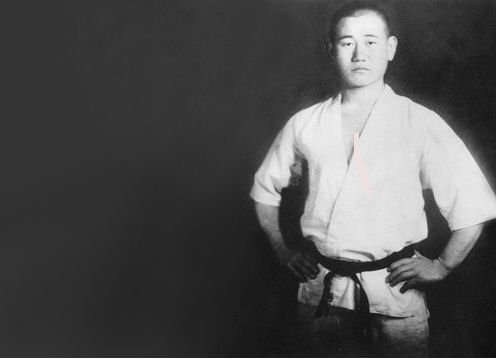
Honoring the Pioneers of Taekwondo; Chun Sang Sup
A while back I started writing a series of posts on the pioneers of Taekwondo. So far I have written one on Lee Won Kuk who founded the Chung Do Kwan, Hwang Kee who founded the Moo Duk Kwan, a commentary on Choi Hong Hi`s Theory of Power (Choi Hong Hi co-founded the Oh Do Kwan) and a post on Ro Byung Jik founder of the Song Moo Kwan. This time I will share what I know about a little well
known Taekwondo pioneer; namely Chun Sang Sup.
 |
| Chun Sang Sup Image Source |
Thursday, 23 January 2014
Honoring the Pioneers of Taekwondo; Ro Byong Jik
A while back I started writing a series of posts on the pioneers of Taekwondo. So far I have written one on Lee Won Kuk who founded the Chung Do Kwan, Hwang Kee who founded the Moo Duk Kwan and a commentary on Choi Hong Hi`s Theory of Power (Choi Hon Hi co-founded the Oh Do Kwan). There is a great deal of material on these three individuals as they were important throughout Taekwondo`s history or maintained a great deal of followers after the Kwan-merger in the early 70s in Korea. I am not saying that Ro Byong Jik is not one of them, but I generally find less material on him and the school he founded (The Song Moo Kwan) when compared to the Oh Do Kwan, Moo Duk Kwan and the Chung Do Kwan and their founders. I want to contribute with one post here so people can learn a little more on this Taekwondo pioneer who was an important factor in early Taekwondo history.
 |
| Image Source |
Wednesday, 15 January 2014
Micro Post; This months quote
This time I have picked a quote from a fellow Traditional Taekwondo exponent; Master Doug Cook. His books on Taekwondo are well written (allthough I never fully agree With what he Writes but then again that is not a bad thing since his writings makes me think) and he is indeed one of very few People out there writing about traditional Taekwondo these days when most books printed about Taekwondo focus primarily on basic techniques, poomsae and competition sparring he Writes about the "whys" of Taekwondo training, the philosophy and history behind the Martial Art. I thank him for his job With promoting traditional Taekwondo.
“The most difficult part ot traditional taekwondo is not learning
the first kick or punch. It is not struggling to remember the
motions of a poomsae or becoming aquainted with Korean culture.
Rather, it is taking the first step across the threshold of the dojang
door. This is where roads diverge, where choices are made that
will resonate throughout a lifetime.”
― Doug Cook, Taekwondo - A Path to Excellence
the first kick or punch. It is not struggling to remember the
motions of a poomsae or becoming aquainted with Korean culture.
Rather, it is taking the first step across the threshold of the dojang
door. This is where roads diverge, where choices are made that
will resonate throughout a lifetime.”
― Doug Cook, Taekwondo - A Path to Excellence
I do not have this book in my Library but his book; Taekwondo: Traditions, philosophy and technique comes highly reccomended (as long as you are not looking for a poomsae Applications book).
Friday, 10 January 2014
Micro post: Taegeuk Cipher DVD clip Taegeuk chil (7) Jang practical aplication
Hi there:-) This is the first real post of 2014 the first one being more of a "what do you want to see next" post. In the (so far only) reply the wish was for practical applications to our forms. I have written and shared quite a few of my own, but at the end of 2013 with the launch of the brilliant Taegeuk Cipher DVDs from Simon O`Neill he shared a few clips on Youtube from the DVD. He has done it again now this time with a puzzling sequence from Taegeuk Chil Jang. The application is almost (about 90%) the same as my own take on the same movement (I use it from a slightly different situation but the same mechanics apply).
I write "puzzling sequence" because from a dogmatic block, kick strike point of view this sequence makes very little sense if any at all. In my personal view the fact that there are so many instanes of the Taegeuk forms set that makes no sense from that point of view is one of the main points in favor of the belief I have that they were designed with more depth in them than what is usually said to be.
So with that being said, here is the clip itself:
I write "puzzling sequence" because from a dogmatic block, kick strike point of view this sequence makes very little sense if any at all. In my personal view the fact that there are so many instanes of the Taegeuk forms set that makes no sense from that point of view is one of the main points in favor of the belief I have that they were designed with more depth in them than what is usually said to be.
So with that being said, here is the clip itself:
Monday, 6 January 2014
2013 retrospect plus what would you like to read in 2014?
It is that time of year again. Time to sit back and see what 2013 brought and look forward to this years writing. I have allready had a survey (17 voters) on what People would like to read more about. The interest seemed to be
- Historical articles/posts
- Practical Application of Poomsae
- Basic Techniques/Poomsae (Performance)
- Philosophy (only 1 vote!)
Subscribe to:
Posts (Atom)